Friday, January 19, 2018

Two Serious Ladies by Jane Bowles (1943)

Two middle class, middle-aged women decide to look for more in their lives.

Book Review: Two Serious Ladies is quirky and odd, it's own creature, about two not-so-serious ladies. Jane Bowles' only novel. Mrs. Copperfield goes off to Panama to live in the red-light district. Miss Goering gives up her New York mansion for a cottage and a chaste menage a quatre. They only meet at the beginning and end of the novel, but their themes intertwine. The two ladies are quite attractive, nervous, strangely blunt, skittish, prickly and difficult, but seeking more from life and somehow find the strength to overcome their insecurities. They have their "own star to follow." Bowles finds her character just a bit humorous, not laughing at them, perhaps, but at least laughing near them. The characters themselves are determined and reckless once they break through their initial fears. Bowles, however, is coy and likes to tease. Two Serious Ladies hints at sexual adventures and daring escapades, but little actually happens as far as the reader can tell. Although dwelling among prostitutes, it's unclear whether Mrs. Copperfield ever has a real relationship with anyone. Miss Goering meets some men, but they are uninteresting, unintelligent, not charming or attractive. In fact, these are the kind of men who send up a score of red flags as more likely to kill their partners than woo them, having serious control and anger issues. Bowles writes with wit and intelligence, though she seems to find her characters a bit ridiculous. There's a lot of quirky to be quirky in Two Serious Ladies. Although they seem to be seeking affairs of the heart, a grand romance, I think what the two ladies really want is, quite simply, friendship. Everyone seems to read the book differently, and this may've been sensational back in the day. Well written and enjoyable, but not quite for me.  [3½★]

Monday, January 15, 2018

The Lover by Marguerite Duras (1984)

A French girl in 1930's Vietnam has a lover.

Book Review: The Lover is about a 15 year-old French girl in an affair with a 27 year-old Chinese man. Marguerite Duras has transformed Lolita or a Mishima novel, has told the story from the girl's perspective. What could be another (& another, & another ...) tired, middle-aged man's fantasy of "love" with a young girl, is turned on its head due to the unique, detailed descriptions, the depth of contemplation and reflection presented, and the unnatural maturity of the girl. The powerful writing and point of view make it escape stereotype. The story (written 50 years after) is told in first and third person, is told in bits of thought, pieces of feeling, scraps of memory, fragments of impression. Most of the passages in The Lover are less than a page, which makes this short book fly. Family is central, a missing father, a domineering mother, a cruel older brother, and a fragile younger one. The setting is Saigon during the French colonial period. Race, too, is here. The lover is wealthy, not overly strong, infatuated, obsessed (he puts her make-up on). They talk little. The girl is intelligent, pondering, learning, exploring the world, religion, love and lust, learning where her desires lie, where her future might be. The Lover is a subtle, delicately told story, major moments come quietly, almost in passing. To tell too much might break it. There is the thought and feeling of the 15 year-old girl seen through the lens of a sixty-year old woman in every line. A small story, but the story of a life. This is a book worth owning, to read again, and find more on each reading.  [4½★]

Friday, January 12, 2018

At the Bottom of the River by Jamaica Kincaid (1983)

A short collection of 10 stories by the Antiguan writer.

Book Review: At the Bottom of the River is the fine spider-web that caught me, and Jamaica Kincaid is the one who spun the web. Kincaid is a deceptively simple writer. She writes: "My tears have been the result of my disappointments," and the reader says, "Ah, she's a simple soul." Then she says: "My disappointments stand up and grow ever taller." The reader says, "Hmm, that's interesting." Kincaid follows with: "Let me have them registered, like newly domesticated animals," and nothing is the same again. At the Bottom of the River  contains precious and delicate stories, without obvious plots. Instead the story is told between the lines: "Someone is making a girl a dress or a boy a shirt, someone is making her husband a soup with cassava so that he can take it to the cane field tomorrow, someone is sprinkling a colorless powder outside a closed door so that someone else's child will be stillborn." We're never told where the stories are set or who's telling them, and they're stronger for what we're not told, existing in some mural of a timeless, universal myth painted by brushes from her homeland. Kincaid doesn't push the reader, doesn't tell the reader what to think. Instead the reader develops all opinions herself, and the stories are more convincing for that. Each story edges into the mind and occupies it. Like an imperial power, Kincaid's writing colonizes her readers. Stealthily, unobtrusively. Like a happy husband, readers think we came up with these ideas on our own. "Girl" is her best-known story, and the other stories follow in similar pattern, except becoming more fantastic, with ghosts and dreams, a repeated desired, idealized, mothering lover. Biblical, Whitmanesque naming. An undercurrent of anger -- there's an edge: "I shall grow up to be a tall, graceful, and altogether beautiful woman, and I shall impose on large numbers of people my will and also, for my own amusement, great pain." She's a Caribbean Woolf, turning her life into a stream of consciousness mixture of indigenous folklore and her own creation myth, creating symbols for her life and her troubled relationship with her mother. As seven of the stories in At the Bottom of the River were previously published in The New Yorker and one in The Paris Review, the magazine format might work better, reading a new story every couple of months or so. The stories being too similar, there's repetition; the first half of At the Bottom of the River was better than the second. The dream-scapes, the myths, didn't hold up as well back to back, with their gauzy, plotless, river of impressions, feelings, memories, and fanciful imagery. Even in such a short book, the stories began to lose their strength. A more realist story or two wouldn't've hurt.  [3½★]

Wednesday, January 10, 2018

Ladders to Fire by Anais Nin (1946)

The interior lives, the thoughts, emotions and fears of 1930's expatriates in Paris.

Book Review: Ladders to Fire is unlike any novel I've read. It's for readers who enjoy character-based, as opposed to plot-driven, novels. This book is all character, no plot. Little changes between first page and last. Some readers might not even call it a novel. Ladders to Fire is the first in Anais Nin's so-aptly named five-novel series, Cities of the Interior, as it explores the inner lives, conflicts, neuroses, insecurities, loves and hates of bohemians in Paris (btw, it's not erotica). Focusing on several women, it's unclear (as is so much here) whether these are separate women or if some are facets of Nin herself. The writing is heightened, intensified, at times it's almost a secret language, Nin's own private symbology: "Sabina was lost. The broken compass which inhabited her and whose wild fluctuations she had always obeyed, making for tumult and motion in place of direction, was suddenly fractured so that she no longer knew the relief of tides, ebbs and flows and dispersions." At times the writing in Ladders to Fire is modernist, a diary of ex-pats in Paris, other times it's surreal, with no sign-posts as to what's real and what's not. The people described are artists, nonconformists, free spirits, a lost generation with turbulent, histrionic lives: "Only the drunks and the insane make sense." The deep psychological studies make the characters seem almost like archetypes. The reader learns more about the characters' personas, their "headspace," than their actual biographies. If you're the kind of person who studies your friends and acquaintances you'll be right at home, and may wonder how Nin would've described you. She's insightful, she truly understands people, sees deep into their motivations, their psyches, to create her intuitive behavioral portraits. One of her characters has a "peculiar flair ... for listening to the buried child in human beings," as does Nin. She examines her characters, her women, over time, in different situations and environments. Nin makes us see that no human being is simple, each person contains a universe within. We need all our intelligence just to understand the group relationships, so we can know each other. I'm not sure Ladders to Fire could've been much longer without disintegrating, but I enjoyed the whole unique and unusual experience. Four more books to go in my journey into the Cities of the Interior.  [4★]

Monday, January 8, 2018

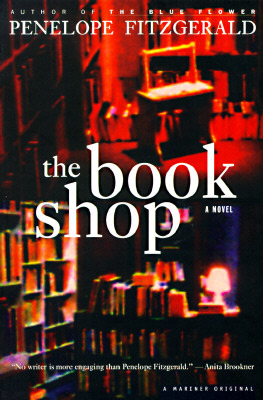
The Bookshop by Penelope Fitzgerald (1978)

A middle-aged widow opens a bookshop in a small English town circa 1959.

Book Review: The Bookshop, once short-listed for the Booker Prize, is wonderfully written with memorable characters from the courageous, determined Christine to the indolent, spineless Milo. It's intelligent and insightful. But the book's arc is so minimal that it's not a "slice of life" but a "sliver of life" novel. Our heroine, though kind and friendly, is feeble and naive, out of her depth, almost friendless. She's set up for failure, but she can be feisty and does have moments of insight: "It sometimes strikes me that men and women aren't quite the right people for each other." We learn that the small town English are small minded, gossipy, and untrue. Bad neighbors. A bookshop succeeds in the neighboring town, so it is not the books that are the problem, but the generous and forgiving widow herself. Her neighbors return her kindness with cruelty.

We applaud her resistance, her sass: "I don't know that men are better judges than women, but they spend much less time regretting their decisions." But we don't see her persist, she's not a long suffering Job-like character, she does not long endure the slings and arrows of outrageous fortune by taking arms against a sea of troubles. Her battles are valiant, but her war is short. Her pain may be harsh, but it is soon over. Her small-town neighbors quickly turn on her, like jackals on a helpless antelope. When she creates a window display of Lolita, the stage is set for meaningful conflict, however, the widow and window encounter surprisingly little resistance, less than that faced by many bookshops which stocked that still-controversial title.

The characters in The Bookshop are marvelously drawn. From the prickly and reclusive Mr. Brundish (hermits unite!) to Christine, the prickly, lovable, persevering-unto-exhaustion, 10-year-old heroine who stole my heart. The small town atmosphere, horrible as it is, is admirably created.

Ultimately, The Bookshop is gloomy and depressing, but the book doesn't lay a foundation to justify that ending. The great authors of the depressing, such as Thomas Hardy or Bernard Malamud, create a story so that the gloomy ending is inevitable, understandable, perhaps unpleasant and disappointing, but the correct conclusion to the tale. The story's aspiration leads to the ending. In stories involving suicide, the critical reader asks: did the character kill herself or did the author kill her? This ending raises a similar question. But perhaps The Bookshop is too small to bear such weight, it's just an overgrown short story, and I'm being unfair. I'll stop. The book is well and wonderfully written, worth reading for the skill of the author. She's clever and discerning, but there's insufficient excellent story to accompany the excellent writing. Was Fitzgerald settling scores? Did she want to demonstrate what she knew about running a bookshop? This made me want to go read some Thomas Hardy to cheer myself up.  [3★]

Friday, January 5, 2018

The Days of Abandonment by Elena Ferrante (2002)

A woman reacts to the destruction of her 15-year marriage.

Book Review: The Days of Abandonment is an amazing, absorbing, emotional read, that may not be for everyone. Ferrante's writing is powerful, vivid, makes every word count. How many novels have you read where you can skim whole paragraphs -- not so here. The language is almost hyper-real, like a photo-realist painting. Superficially, this is simply the story of Olga, a woman scorned, betrayed, but Ferrante's ability to go profoundly into the character, to examine and create unique, individual depths and details keeps this from being the easy stereotypical story of a broken marriage. The author mines the character and situation for wisdom and insight, drilling deep into Olga's psyche, the ghosts of her childhood, her damage. At one point in The Days of Abandonment Olga realizes that her husband "had not taken away the world, he had taken away only himself." Ferrante measures the distances between people, between spouses, lovers, friends, parents and children. It's the evocation of these distances, the isolation of human beings, that makes this book work so well. I was sucked into the story, could feel it. Even those moments which were too much, I could still relate. Some points just seemed obvious, yet still valuable: "What a mistake ... to believe that I couldn't live without him, when for a long time I had not been at all certain that I was alive with him." Life has cliches. The Days of Abandonment is such an individual story, so unique to the one character, that it won't work for everyone. In life it's difficult to connect. That's how it is between people when you're an adult. This is an adult book, written by an adult, to be read by adults.  [5★]

Wednesday, January 3, 2018

Best Reads of 2017!!!

Yes, it's "Reads," because most of my books weren't from 2017. As I did last year, I won't be presenting a top 10 list or anything like that, but just have a little discussion about my books from the last year that were worth thinking about.

Fiction: My best novels published in 2017 were Autumn by Ali Smith, and Lincoln in the Bardo by George Saunders. Autumn had a prickly and somewhat unlovable main character (always a good thing), but was a subtle & delicately drawn book that I enjoyed. The key for me was the beautifully created relationship between a young girl and an old man. Perfect. I'm sure some of Lincoln in the Bardo went over my head, but I still recognized quality writing combined with ineffable creativity. Loved the weird! From two of my old favorites, wonderful were Memento Mori by Muriel Spark and Dark Tales (Penguin's new collection of previously published stories) by Shirley Jackson. Also read Invisible Man by Ralph Ellison. Blew my mind! American history as it needs to be understood.

Nonfiction: I went in for some books discussing American race relations, and they were fantastic. We Were Eight Years in Power and Between the World and Me by Ta-Nehisi Coates were both amazing. At only 43 (as of last Monday) he's still a young man, and I expect so much more from him. I think he has the chops to justify my great expectations, to be the next James Baldwin (and that's not a black comparison, I can't think of anyone greater than Baldwin). I also read Baldwin's I Am Not Your Negro, which I only mention to praise the documentary of the same name, because it's required viewing and I wish every high school in America had 10 copies. Two quick additions: (1) Look for the poem "They Feed They Lion" by Philip Levine, the same sentiments in poetry; (2) Things Fall Apart by Chinua Achibe, which, although fiction, made me understand the effects of colonialism like nothing I've ever read. Lost in the shuffle was Mary Dearborn's biography of Ernest Hemingway, which told me more about the American author than I expected to ever know, and revealed the man had far more issues (beyond toxic masculinity) than we ever knew.

Poetry: Disappointingly, I didn't read much poetry this year. Two of my favorite poets died in 2014 and 2015, and their final works were published in 2017. I read three books by Philip Levine, and though his books aren't always consistent, he writes individual poems that just kill me. Bill Knott had a life-long collection of his poetry published, I Am Flying into Myself: Selected Poems 1960-2014, which has many of his brilliant and bizarre poems. A worthy commemoration of a largely unknown career. I also read Devotion by Patti Smith, which was a memoir about writing and creativity, and made me want to delve into her poetry in 2018. Also have to mention the gargantuan tome of Sylvia Plath's letters. Too large to actually read, but dipping into her letters reinforces what a talent she was.

Classics: A big year for classics. Read ten of Shakespeare's plays, which I didn't think I could. I got a lot more out of them than I thought I would, and was amazed how Shakespeare wrote so far ahead of his time, addressing race (Othello), anti-semitism (Merchant of Venice), and humanity in general. Beloved wasn't fun, but shows why Toni Morrison deserves her Nobel. Read most of Austen and the Bronte sisters, which reminded me how much I like their books. Okay, Agnes Grey by Anne Bronte is not a favorite, but her Tenant of Wildfell Hall is fantastic.

Forgotten Gems: Stumbled on two (new to me) authors, one Chinese (Qiu Miaojin), one Mexican (Juan Rulfo), this year, which emphasized how much undiscovered gold is out there. Both had tragically little output (Qiu suicide, Rulfo, politically self-imposed censorship), but Qiu's Notes of a Crocodile and Rulfo's Pedro Paramo were highlights of my year.

Read a short story at the end of the year, "Cat Person" by Kristen Roupenian, which was a breath of fresh air -- decidedly contemporary, and so decidedly creepy in its own way. A good, maybe not great, year in reading.  🐢