Farm animals revolt against the cruel Mr. Jones to establish a bucolic utopia.
Book Review: Animal Farm is an allegory, a parable, a metaphor, a fable, a roman a clef ... a classic. Easily accepted as just a children's story about talking animals (I love stories with talking animals!). Yes, it's also a history: identifying which animals are the Czar (Mr. Jones, also Capitalism), Marx, Lenin (both Old Major), Stalin (Napoleon), Trotsky (Snowball), Molotov (Squealer), etc. is fun, but so not the point. Beyond the heart-breaking, tragic figure of the workhorse Boxer, is a simple and moral lesson, the propaganda wrapped up in Orwell's "Fairy Story." Contrary to conventional wisdom, Orwell is not condemning Socialism, which is actually presented quite sympathetically in Animal Farm. Instead, he shows how the rosy promises of Socialism are used as the sweet bait for the evil trap of Fascism (what he viewed as the true name for Stalin's Communism). The reader can't help but think that if only the new farm had been guided by moral leaders the farm's resources would've been more than enough for all the animals. But Orwell's cynicism may be shown by his failure to present a class of animals from which such leaders could be drawn. Even today we see resource-rich countries that devolve into misery and totalitarianism because of greedy, selfish, uncaring leaders (and other post-colonial issues). Human nature ... maybe. For Orwell the evil isn't socialism but fascism, and that lesson plays out repeatedly in our modern world. Reading Animal Farm, I saw not only a foreshadowing of his next novel, 1984, but elements in the news right now. [5★]
Monday, February 12, 2018
Saturday, February 10, 2018
Tar Baby by Toni Morrison (1981)
A mysterious stranger upends a family.
Book Review: Tar Baby is the archetypal story of the stranger, the outsider, the Other, who enters, exposes, and disrupts the settled but hidden dysfunctional workings of a family. In doing so he exposes the mixed attitudes that blacks and whites have about whites and blacks. At the same time, while not a "beach read," it is the most accessible, easiest, and closest to fun of any of my Toni Morrison reads. As much as I recognize her immense talent (hey, she won the Nobel), I know her books aren't always fun to read. Isn't that one definition of a Classic: a book you know is good but avoid reading? Tar Baby begins in the Caribbean where a wealthy white man and his much younger, mentally ill white wife have settled with their black servants, another married couple, and their light-skinned niece. There's little subtlety in Morrison's images -- I should mention there's a black baby-sealskin coat. Ouch! Speaking of beach reads, here a quick makeover transforms the ugliest kid in school into the prettiest and the two characters who detest each other are destined to fall in love. The story reminds of Down and Out in Beverly Hills (1986) (a remake of Renoir's Boudu Saved from Drowning (1932)). But Morrison takes the story several quantum leaps beyond the simple and expected. Easy read -- difficult issues. She examines white attitudes toward blacks, black attitudes toward blacks, black attitudes toward whites. She mixes in class as well as race: economic factors, employment, working for a living, that complicate the racial picture. Indoor workers versus outdoor workers; native culture versus foreign culture. In Tar Baby the familial and racial patterns, rituals, and expectations have been upended, but few of the characters truly reassess their thinking. After all, it's a version of a love story -- and what does love mean? Where is the tar baby? One might think Son would be attracted to a proud black woman, but instead he finds the "yalla" Jadine irresistible. Son's a chauvinist at heart and engages in stalking, sexual assault, domestic violence, and worse, but is still endlessly attractive to Jadine. Overlaying the plot is Morrison's symbolic conflict between nature, the black world, confronting the white world's crumbling civilization. The colonial occupation destroyed nature and native culture on the island, and the survivors are still trying to pick up the pieces. Morrison asks difficult questions about finding a place along a racial spectrum, a human spectrum, and provides no easy answers. [4½★]
Friday, February 2, 2018
Winter by Ali Smith (2017)
A family accidentally gathers at Christmas.
Book Review: Winter, the second book in Ali Smith's seasonal quartet, expands on the wonderful Autumn. Winter is about family, art, Christmas, world events past and present, aging, politics, disconnected reality, and simply dealing with life as one has to and does. In both novels it's apparent that Smith is at a point in her life when she just wants to talk about her thoughts on life in the world. She wants to talk about Brexit (in Autumn), the refugee crisis (in Winter), and the nonsense in America, so she does. Her vehicle is the novel and all the characters are Smith speaking to us. They say all characters in a dream are really the dreamer; all the characters in Winter are really Ali Smith and they all have something to say. Some characters are prickly or confused, but she let's us see why by going back in time and memory to pivotal moments in their lives. The Ban the Bomb movement plays a big role. The book is choppy, mixing time and memory, history and viewpoints (with helpful road signs for the unwary reader). It can get very meta: the narrator, maybe the author, sometimes who-knows-who isn't shy about stepping into the spotlight. But it had to be written this way to work as it does.
Smith again weaves in Dickens, as A Christmas Carol is the template -- Sophia being our Scrooge du jour. Although Winter is being hyped as being better than Autumn, I don't see it. We just have more to work with now that we have two books. Winter is simpler, more accessible, more heartwarming, and has a "happier" ending. It's enough to bring a Grinch's heart up to room temperature. Winter also has more humor. A Hallmark Movie (or teen movie) device is employed as a comic subplot. We meet a too-good-to-be-true, practically-perfect-in-every-way immigrant, unsubtly named Lux, who brings light to the family. Or is she St. Lucy whose feast day was once the Solstice? She speaks perfect English, but despite spending much of her life in the Commonwealth she doesn't understand English idioms. Funny immigrants! We also meet the unloved and unlovable Art, who never knew his father, whose mother (Sophia) was too busy making money to have time for him or his father, and packed him off to boarding school asap. Since this is a book about art the characters may either be talking about art or Art. Ha! Another artist is introduced (a sculptor this time), the talented Barbara Hepworth (of Hepworth Wakefield art gallery fame). Compared to Pauline Boty in Autumn she's given short shrift. Smith also uses straight reportage to demonstrate that America's President is a pea-brained, vindictive bully, quoting his clumsy and petulant pandering efforts to reclaim "Merry Christmas," because in Winter we're talking about Christmas. This doesn't require great art, and sadly, by the time Winter hit the bookshops it was out of date because of even more heinous comments. This book seems more rushed than Autumn, simpler, more obvious, more slapdash. A tragic current event in Britain is included for no apparent reason. It's best to read Autumn before Winter -- there are a few overlaps and many similarities. Now, I can't wait for spring, erm, Spring. [4★]
Wednesday, January 31, 2018
The Beautiful Struggle by Ta-Nehisi Coates (2008)
A memoir of growing up in Baltimore by the Atlantic writer and culture critic, author of Between the World and Me and We Were Eight Years in Power.
Book Review: The Beautiful Struggle isn't necessarily written for white people. I think Coates wrote it for himself. Maybe his family. Some close friends, perhaps. The young Ta-Nehisi Coates is a bit Oscar Wao (see the mythic map of "Old Baltimore" replete with serpent and dagger -- there's also a helpful family tree). He doesn't fit. He's into Optimus Prime, spells, elves, and not really tuned-in to the world around him. Which is dangerous because a beating or death can literally be around the next corner in the years of the crack crisis. He refers to a neighborhood as "a duchy," "a land of swords," but he also "knew that to be afraid while on the way to school was deeply wrong." Coates and his father, Paul, are the two poles of this memoir (dedicated to his mother). His father was a vegetarian, veteran, former Black Panther, publisher, and librarian at Howard University, who had seven children by four women, but tried to be more or less present in their lives. Strict, even harsh, determined, asking "who would you rather do this: me or the police?" The memoir is stunningly and embarrassingly honest; it must've been wrenching to write.
A recent article places this memoir in sharp relief. "Ta-Nehisi Coates is the Neo-Liberal Face of the Black Freedom Struggle" is the title of Cornel West's December 17, 2017, critique of Coates in the Guardian, and a subsequent tweet by West, which was then re-tweeted approvingly by an American white supremacist. West considers Coates' view of black America too narrow, terming it "apolitical pessimism." West asserts that Coates doesn't address Wall Street, the military, the insular black elite, and "dynamics of class, gender, and sexuality in black America." The emotional center of West's criticism appears to be what he considers Coates' illegitimate comparison of Barack Obama to Malcolm X in We Were Eight Years in Power. In The Beautiful Struggle, activist Paul Coates comes off as someone who Cornel West might've approved of far more than he does the son. The generational differences are telling, both for the history of the movement and the development of individual leaders today.
Maybe it's just me, but at the end of The Beautiful Struggle I got emotional. Probably I didn't realize how much I'd been pulled into the story, perhaps it was just a release of feelings. The focus on the idea and importance of Howard University, which Coates often calls the Mecca. Regardless, there's power in this unique book. Not many people lived this kind of life, it's not a universal story, but everyone can understand it. [4½★]
Monday, January 29, 2018
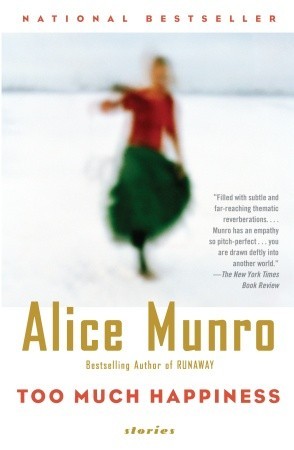
Too Much Happiness by Alice Munro (2008)
A collection of ten stories by the Canadian Nobel laureate.
Book Review: Too Much Happiness isn't all that happy, it can go to the dark and harsh and strange. Most of the stories try to find ways to scrape a little redemption from the pain and jolts of life. Not all. Be prepared for stories that begin in the safe and ordinary, but then venture into the grimmer realities of a life you don't want -- it can be a tough go. Not for the faint of heart. The first three stories were some of the best, but that set a good tone for the rest of the book: I always expected excellence and I always got it. You will not find writing in Too Much Happiness that is cliched, or easy, or that panders to the reader. Even the lesser stories were strong, enjoyable, and well worth reading. The entire collection provides ample evidence of Alice Munro's insight and intelligence; I see why she deserved to win the Nobel Prize. Her stories proceed with mathematical predictability, take some tangents, and knock the reader off the proverbial feet. One recurring theme of Too Much Happiness is seemingly decent people being unspeakably cruel; a second was people trying to find just a little something of their own in the midst of a lot of nothing. Three random notes: (1) the title story, the longest in the book, is quite different from all the others, and made me wonder if perhaps Munro was considering turning it into a novel; (2) for me the ending of the third story, "Wenlock Edge," baffled me and I was lost. No spoilers, but if this happens to you, the explanation is simple and easily found on the internet; (3) an extra added feature for any aspiring writers is that reading Too Much Happiness provides a perfect lesson on how to craft a short story. Alice Munro is noted as a short-story writer -- I'm not sure if she's written more than one novel. In the story "Fiction," a character's reading a book that "is a collection of short stories, not a novel. This in itself is a disappointment. It seems to diminish the book's authority, making the author seem like somebody who is just hanging on to the gates of Literature, rather than safely settled inside." No Ms. Munro, you're safely inside. [4½★]
Friday, January 26, 2018
New Worlds, Old Ways ed. by Karen Lord (2016)
A challenging collection of eleven speculative fiction stories by Caribbean authors.
Book Review: New Worlds, Old Ways is quite appropriately subtitled "Speculative Tales from the Caribbean," and spotlights "new writers and new works" of speculative fiction from English-speaking countries. As someone who lives 1,000 miles (1600+ km) from the nearest ocean, these stories could be culturally and geographically exotic, but were still familiar. As I learned from reading Jamaica Kincaid's story collection At the Bottom of the River, speculative fiction can include digging deep into the mythic and archetypal, as in "Once in a Blood Moon" by Tammi Browne-Bannister. That story had the place of honor in kicking off this collection. Myth, magical realism, speculative fiction, it's all kind of a blur. The story also involved sea turtle conservation and probed the connection between humanity and nature, so how could I not like it? The next story by Summer Edward, set in Puerto Rico, took me into a bewildering psychedelic haze. The next two stories were straight science fiction ... and from there we had a ghost story, horror, magic, dystopian ... oh, and more SciFi. There's a wonderful mix of genres in New Worlds, Old Ways, each story is different from the one before. And not a clunker in the bunch. Some were better than others, but I enjoyed them all.
As a tangent, I not only wondered about the eternal question of how to pronounce Caribbean (accent on second or third syllable?), but also the relationship between the various English, French, and Spanish speaking countries. As one story noted: "You are from a region where the nations share an overarching history. You belong more to a region than you do to a nation. You can travel anywhere along this chain of islands and find customs and traditions that remind you of your own." New Worlds, Old Ways included authors from Barbados, Trinidad & Tobago, and Bermuda. It's easy for the under-educated and ill-informed to dismiss other cultures, other countries. But after reading other literatures, the reader soon learns that we're all just people, with brilliant ideas, great stories, and a surplus of humanity to embrace. I was quite fortunate that my local library had this book. If you're interested in "reading 'round the world," look for New Worlds, Old Ways. [3½★]
Monday, January 22, 2018
Like Water for Chocolate by Laura Esquivel (1989)
The youngest daughter, required by tradition to remain unmarried to take care of her mother, finds that her emotions cannot be contained.
Book Review: Like Water for Chocolate was a mixed bag. I expected to love it to pieces and thought the first half was wonderful. The character of Tita reminded me of my own mother, private and reserved, but who made every meal with total care, made every meal perfect, as a way to show her love. Just as Tita, emotions blocked and thwarted at every turn, magically releases her feelings into delicious meals. The book is filled with wonderful family recipes, lovely descriptions of cooking, the warmth of the kitchen. There are family traditions and sayings ("When the talk turns to eating, only fools and sick men don't give it attention"). The characters, though not complex, are wonderfully drawn. The "magical realism" (or whatever you want to call it) is delightful. There are a few bumps along the way, but the reader is confident all will work out in the end. Then somewhere after the mid-point of Like Water for Chocolate it all went wrong for me. The main love interest is a selfish, jealous, cowardly brat ("I'm only sleeping with your sister to be close to you." Hmm?). Not attractive at all, unless we want to perpetuate the myth that violent, possessive men are "real" men. Rape does not make a woman fall in love. And this is the good guy. The competing love interest, a decent person, is presented as not a real man -- too much a saint, I guess. The characters keep saying that they're "worried what people will think," but they're not, they're only worried about getting caught betraying and hurting their loved ones. Marry your sister's boyfriend. Sleep with your girlfriend's sister. Sleep with your sister's husband. Cheat on your fiance. All just fine, with the only concern being how to get away with it. Their actions are just an effort to justify violating the second rule of life: "don't hurt those who love you." Loved ones get hurt for no reason and other wrongs are treated lightly. There are bad lessons being taught here. Reading the first half of Like Water for Chocolate I thought it was going to be an all-time favorite. I took the second half a little too seriously, and it left a bad taste. [3½★]
Subscribe to:
Posts (Atom)