Friday, November 29, 2019

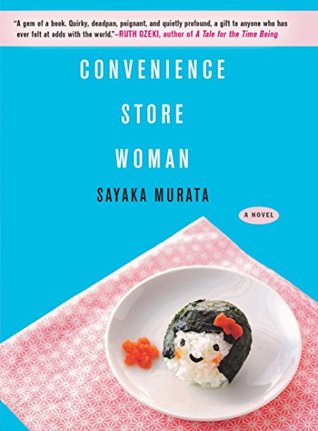
Convenience Store Woman by Sayaka Murata (2016)

A 36-year-old woman works in a convenience store for 18 years excluding all else in her life to the consternation of family, friends, and co-workers.

Book Review: Convenience Store Woman is one of those rare books that feels as if it was written just for me, like We Have Always Lived in the Castle, My Year of Rest and Relaxation, or just about any of Kafka's short stories. I know Keiko here as I know Merricat. This book is 163 pages long and I need about that many pages to discuss it as I found myself relating on too many levels. In one sense it's about finding the life that works for you no matter what the rest of the world thinks. Being a store worker is for her "the only way I can be a normal person." Many of us work hard at being normal: "It was the first time anyone had had ever taught me how to accomplish a normal facial expression and manner of speech." But it's okay to be seen as odd, different. Live your life, don't let others live your life. It's also about the joy that can be found in a job well done, the satisfaction of of having complete command and understanding of what you're doing and how to do it. Keiko can read customers' "minutest movements" and her body "acts reflexively in response." Convenience Store Woman also looks at how a demanding job in the old world can start to take over life. Laundry, groceries, cooking, clothing all have to fit into the dictates of work. The job begins to define all elements of life. Another side of this view is the completely unnatural world that is modern work, divorced from us as humans, and what the working world makes us into: cogs in the machine. "At that moment, for the first time ever, I felt I'd become a part in the machine of society. I've been reborn, I thought. That day, I actually became a normal cog in society." Temporary, easily replaced, just another widget along the conveyor belt. Although Keiko, the main character in Convenience Store Woman, has very little life, actually it's the same and no less than the life of anyone working for someone else. Like Keiko we're all temporary. It can be read as about disability or depression or any need or lack with which we have to cope, any way that we can. Yet I also simply wanted to read it realistically. What if this was me. Toward the end of the story when everything starts to fall apart, it becomes clear that Keiko would make an excellent manager, and perhaps only her being considered odd has kept her from being promoted. A thoughtful book that made me think, that took me inside someone else's skin, but also a quick, enjoyable read that I related to my own life. After reading I have two wishes: (1) that Sayaka Murata will now have more of her work translated into English and other languages, and (2) that Keiko gets to be in charge of her very own convenience store.  [5★]

The Wounded and the Slain by David Goodis (1955)

A couple goes to Jamaica to salvage their failing marriage, which turns into a dangerous walk on the wild side.

Mystery Review: The Wounded and the Slain is ambitious, a novel that wants to fit into that lurid nether world between crime and straight fiction, like a low-calorie version of The Bonfire of the Vanities. David Goodis (1917-67) examines what happens when the unthinkable intrudes on everyday life, when that everyday life consists of an alcoholic husband and a traumatized wife. The Wounded and the Slain is an odd sort of walk on the wild side, a venture into the unknown, only here the unknown is Jamaica where a married couple go to save their almost crumbled, wholly uncommunicative nine-year marriage. The story is alternately told by the wife and husband. He a straying and committed and eager drunk, rapidly losing touch with any logic in the world -- "To do anything logically was too much of an effort ... it was nothing more than a blindfold that covered the inner eye." She guilt-ridden, haunted by repressed childhood memories (which Goodis also touched on in Of Tender Sin (1952)). They both find alternatives and options in Kingston, one in the swanky, walled resort, the other in the violent slums. Eventually both risk their lives trying to do what they think is right. Not a mystery (though a death occurs), more a seamy slice of life Nelson Algren-style. When readers cite hard-boiled novels as angsty and existential, The Wounded and the Slain is what they're talking about. Just enough thoughtful moments to let the reader think: "In prison the art of wrongdoing has many professors." A taste of what might happen when one gives up on everything. The ending is just hard-edged enough to comfortably fit with the rest of the book.  [3½★]


Monday, November 25, 2019

Woman in the Dark by Dashiell Hammett (1933)

A fleeing young woman stumbles upon the home of a man recently released from prison, but all is not as it seems.

Mystery Review: Woman in the Dark is subtitled "a novel of dangerous romance." I guess. More a long short story than a novel (or even novella) and the romance is on the rough and abrupt side, but what does one expect in 70 generously margined pages. Hammett's protagonists seem tossed on the sea of fate, knowing that there's little about life they can change so it's barely worth even trying, though they do. His heroes mostly resign themselves to accepting what comes, however painful it might be. The Ned Beaumont kidnapping scene in The Glass Key is the epitome of this, in which he calmly accepts beating after beating like a turtle pushing against a wall. Our protagonist here has less to say and do than most, but the titular "Woman in the Dark," a German immigrant (apparently not a refugee) rises to the occasion. And the bad guys are pretty bad. The story is too short though, really needed to be expanded and developed, so ends up just a quick bite to enjoy and move on. Woman in the Dark was also a 1934 film with Fay Wray (the scream queen of King Kong fame). The movie is no better or worse than the book, but at least fleshes out the skeleton presented here.  [3★]

Thursday, October 31, 2019

The Heroic Slave by Frederick Douglass (1853)

A slave escapes from Virginia and travels through Ohio on his way to sanctuary in Canada, and that's only the beginning.

Book Review: The Heroic Slave is the only work of fiction written by the great abolitionist, Frederick Douglass. Who knew? My reading of this was inspired by reading Ta-Nehisi Coates' first novel, The Water Dancer. The Heroic Slave is more short story than novella and more advocacy than story, but an interesting rarity nonetheless. As might be expected of a first piece of fiction, it relies on unbelievable coincidences, but the periodic willing suspension of disbelief is required calisthenics these days, anyway. Although fiction, this is also a slave narrative, with the climax of the story based on an actual but generally unknown event from 1841. The story, however, comes second to the more didactic points Douglass wants to make in The Heroic Slave. He makes clear to those who might fail to understand (this was America in 1853), that slaves were human beings: "children of a common Creator -- guilty of no crime -- men and women ... chained ...humanity converted into merchandise ... all to fill the pockets of men ... who gain their fortune by plundering the helpless." He exposes the hypocrisy of slavery existing in a country that not long before had fought for its freedom, but when slaves did the same labeled them criminals. A white character says, "Our difference of color was the only ground of difference ... it was not that his principles were wrong ... for they are the principles of 1776." To reinforce that point Douglass names his mighty and "noble protagonist" Madison Washington. Reminding his readers that in America the proper response to tyranny is revolt. Having escaped slavery in 1838 at age 20, Douglass later became a leading abolitionist voice and publisher. He was an adviser to Abraham Lincoln during the Civil War, also serving as an ambassador to the Dominican Republic and consul-general in Haiti. Douglass was an early supporter of the women's right movement, attending the Seneca Falls Convention in 1848. Although The Heroic Slave is brief and perhaps not great literature, it's an authentic voice of the times and an insight into the American past that is not even past.  [3★]

Wednesday, October 30, 2019

Of Tender Sin by David Goodis (1952)

A Philadelphia insurance agent begins to lose touch with reality, threatening his marriage, his job, and soon his life.

Mystery Review: Of Tender Sin isn't a mystery about crime, at least not at first. Here the mystery is about what is causing Al Darby's visions, transforming them into an obsession that tears his life apart. (n.b., "Darby" is also a township in Delaware County adjacent to Philadelphia.) My second novel by David Goodis, this is worlds apart from the chaste struggle against fate that was Dark Passage (1946). More sensual (almost erotic), than the former novel, but all in service to a plot that takes it to the edge. Goodis does not fall into the typical "madonna or whore" cliche; instead each female character is a lot of one and a bit of the other, making the roles more credible. Of Tender Sin is a psychological mystery, consisting of one man's struggle with repressed memories and taboo passions. These pressures lead our protagonist to go for "a walk on the wild side" in the seamy districts of Philadelphia. Goodis paints Philly street by street as carefully as Joyce did Dublin. Wherever the plot might momentarily unravel, Goodis quickly saves it with his stunning skills -- he can write suspense with the best of them. A quick entertaining read with just enough grimy verisimilitude to make it a genuine noir novel, Of Tender Sin is an odd book out, but no less enjoyable for that.  [3½★]

Wednesday, October 23, 2019

The Coral Sea by Patti Smith (1996)

A remembrance in poetry of Robert Mapplethorpe.

Poetry Review: The Coral Sea is a collection of Patti Smith's writing about the memory of Robert Mapplethorpe who passed in 1989, at least up to that point in time (1996). I read the revised version published in 2012, which added more poems to the original edition. It consists of a preface to his book Flowers, a poem for his memorial, and a number of prose poems that tell "our story." The collection is well illustrated by both their photographs. As such, it's something of a prequel to her memoir Just Kids (2010), the story of their struggling young "ambitious artists" days in New York City. I'd suggest, however, to read it after if interested. Elegy seems to bring out the creator in Patti Smith. On her groundbreaking, combining punk with poetry, first album Horses (cover photo taken by Mapplethorpe) she included an "Elegie" for Jimi Hendrix. In her three memoirs she recollected Mapplethorpe (Just Kids), her husband Fred "Sonic" Smith (M Train, 2015) and Sam Shepard and Sandy Pearlman (Year of the Monkey, 2019). The Coral Sea is Smith's poetic remembrance, Just Kids is her memoir of the same. The latter is the stronger work, which led me to wonder if memoir is the natural outcome of what Smith calls "the dried-up-poet" syndrome. So much of poetry comes from an author's own life. If as one ages it becomes harder "to make it new," is not memoir, which also flows directly from one's own life not a natural avenue to channel those creative but now maybe less energetic impulses? I know of no poet to compare Smith with, from which she sprang. She is in love with images, she sees all, images and elements appear, vanish, then reappear in another poem, repeating words and images tightly interwoven throughout the book. The poems are visual, but she hears the sounds of her poems, every poem is capable of being read aloud. No, not just read aloud, declaimed, orated, spoken from a stage. Even sung, even danced. The whole is a metaphoric voyage, with people from their lives given new identities. She has a fearless poet's soul, is afraid of no combination of words, willing to write a "reign of tears" or "tiny arrows burning with the seductive poison of love" or "only Cupid in mischievous sleep could muster. And only M in cruel awakening could master." Many poets are far too cool to write those words, but Smith's poetry is fiery, rich, not cool. One line is "No one could enter a soul composed of tears, for one would surely drown." To me those words succeed and fail on several levels. Some favorites are "After Thoughts" and "The Herculean Moth." From these poems I get less a sense of who Robert Mapplethorpe was than who Patti Smith thought he was or what he was to her, for she seems to inhabit his skin in these lines, at times it's unclear where Smith begins or Mapplethorpe ends. She writes of him warts and all, confident that he transcends earthly flaws, traits, and peccadilloes. For her they both needed and collected amulets, tokens, talismans, touchstones, relics and ritual, objects with meaning, myth, and magic. Everything is visceral, tactile, texture. She runs more to emotion, but there is food for the intellect here also. In the final analysis the poems in The Coral Sea are heartfelt, honest in their fanciful way, with a meaning that Smith understands more than anyone. There are many personal and opaque references. For instance in the last line of the book she writes "commending these same wings beneath the folding arms of the deaconess of his soul"; Mapplethorpe died in Deaconess Hospital. For what is infinitely intimate to her, she gently and generously allows us to see through the door she's opened.  [3½★]

Tuesday, October 15, 2019

Year of the Monkey by Patti Smith (2019)

In her third memoir, Punk poet Patti Smith selects moments from 2016, an election year and the Year of the Monkey.

Memoir Review: Year of the Monkey, as with her two previous memoirs, Just Kids and M Train, remembers lost friends and lovers. Just as she eulogized Robert Mapplethorpe and her husband, Fred "Sonic" Smith in those books, here she focuses on playwright Sam Shepard and writer Sandy Pearlman. Lamenting those passed is a theme Patti Smith has developed as far back as her memorable first album, Horses (1975), which included the song "Elegie" dedicated to Jimi Hendrix ("my head is aching as I dream and breathe"). Year of the Monkey relates occasional events from 2016 and as in her previous works (including the short book Devotion in the "Why I Write" series) she expands on her belief in the power of objects, memory, ritual, sympathetic magic, the importance of people she's known, places she's been, her deep emotional reactions, and gives wide latitude to whimsy and the creativity latent in the world. Her reflections on books she's read (Roberto Bolano's 2666; Meditations by Marcus Aurelius) add interest. As 2016 was an election year in the U.S., Year of the Monkey incorporates a fair share of Trump bashing, also. Compared to the books mentioned above, this one has the smallest palette and is the most self-indulgent (why constantly describe her unappetizing breakfasts) and the most fictionalized, but at age 70 perhaps she's earned that right and it's easy enough for the reader to indulge her in this short memoir. Even as Patti Smith laments "the dried-up-poet syndrome," her poetic soul is never far from the surface.  [3★]