A memoir of what it means to be a black man in America, addressed to his teenage son.
Book Review: Between the World and Me is an individual book, an awkward book, a necessary book. Coates uses three unique phrases to define his argument (this is a memoir based on an argument in the form of guidance). The first is the "destruction of black bodies." By this Coates identifies and emphasizes the physicality of racial prejudice and discrimination in America. Those multi-syllabic words harbor the actual death of a body. Black people die, taken from their families. Their broken bodies break hearts and dreams. Not theoretical, not academic, not abstract. The second phrase is "Americans who believe they are white," which embodies the concept of an identified controlling class, which thinks they are above retribution, beyond law, and exempt from the simple human morality we expect of each other. "Whiteness" is a shield that permits the destruction of black bodies. The third phrase is "the Dreamers," identifying those white people who believe they are entitled to the American Dream and everyone else is proscribed from the American Dream (when I hear "Dreamer" I think DACA, but an interesting coincidence). Coates very much comes from his own unique point of view; an intellectual who writes for the Atlantic, knows and explains history, and grew up black in Baltimore. Between the World and Me is awkward and uncomfortable. Since few white nationalists will read this book, few people will think Coates goes too far, but there will be a number of people who think he doesn't go far enough; he's still discussing Malcolm v. Martin (this is a history). If his intended audience is liberals, primarily white liberals, this is an early and important, step in his discussion. Coates wants to make real the extant of human suffering caused by the racial divide. In part through his own powerful personal history, he shows the constant effect racial violence has on the minds and bodies and lives of black men, how the harm to black men is severe, persistent, and pervasive. He also makes clear the source of racial divide and racial violence. There are times when the reader will say "not all white people," "not all black people," and "what about other people?" Some may also say "where are the women (women aren't excluded, but aren't the book's focus)?" But all these comments miss the point. Coates is making a sweeping statement from his own life and lessons, overstatement, generalization, and glossing is the only way to accurately describe the situation we confront. Cold facts, qualifiers, caveats, exceptions create a false picture that avoids the reality of America. This may make some people uncomfortable, there are so many "what abouts?", but that's not the mission of this book. It should make people uncomfortable, it should be awkward. The current state of America, the white backlash against Obama, officially condoned racism, white supremacists filling front pages and news reports, is unacceptable. Between the World and Me is a valuable and necessary book. Ta-Nehisi Coates is an intelligent and insightful commentator, we need his input. We need his unique and powerful views. If nothing else, he wants to make clear that a post-racial America is a myth. Coates allows he has no solution: the problem is white people and they have to solve it themselves; black people can't do it for them. As such this book is only one step, one slice of the whole. Coates mentions a comment from Saul Bellow: "Who is the Tolstoy of the Zulus?" He later realizes that Tolstoy is the Tolstoy of the Zulus. But from that quip we realize we can have hundred more Tolstoys, a hundred more Einsteins, a hundred more Edward Jenners. We need them all. We also need the many other stories, many other views of the society we face, from many other people. From all people. And, yes, white people are going to need to solve their problem, which seems to be getting worse daily. Coates knows that white society is going to take everyone down with it: whites are not just destroying the bodies of humans, but the Earth itself. A necessary book. And then you need to read another book. [4½★]
Friday, October 6, 2017
Wednesday, October 4, 2017
Devotion by Patti Smith (2017)
An expanded version of Patti Smith's 2016 Windham-Campbell lecture, part of the Why I Write series.
Book Review: Devotion is a book written by an artist. Patti Smith exists as an artist. A musician, poet, photographer, memoirist, reviewer, Patti Smith is all of those, none of those, more than those; she's an artist. All is art to her, and as such, she is both more and less known than she might be. Devotion is made in three parts, but more than three parts. This tiny book holds so much: two brief memoirs, a short story, two short transitional pieces, two poems.
She begins with a brief poetic prologue on inspiration. The first section is memoir, called "How the Mind Works." Much as she did in M Train, Smith describes a trip to Paris and Ashford in England (where she visited the grave of Simone Weil; she includes a poem written there). But more than memoir, she is showing the reader what it is to be an artist. She shows how creativity works, how her short story "Devotion" (the next section of the book) came to be written. Smith shows herself open to experience, willing to be uncomfortable, lost, caught in the rain, cold, up too early, up too late. Exploring. She sees things when we're not used to looking at them, where we're not used to seeing them. Her mind is open to seeing things new, free of distractions (no cell phones here). She sees everything fresh, her senses are open, her mind uncluttered but ready to be filled with imagination and inspiration. Her emotions are open, but immature emotion is not enough. Emotion is insufficient without an awareness of art. Smith shows how she relates what she sees to what she knows: music, poetry, painting, sculpture, books, films ... artists. But the artist must have read enough poems, seen enough films, devoured enough books, viewed enough paintings and sculptures to be aware of, to make these connections. A seamless whole. There may be coincidences, there may be synchronicity: at the last minute she chose a book by Simone Weil for her trip; while there a journalist gifts her a book by Weil; her niece is named Simone. Food is intimately described. She takes pictures, but very few, and each with a singular purpose. Smith sees the world as filled with emotion and dream, she relates her dreams and her dreams are not much different than how Smith views the world; I'm not sure how she keeps them straight (the last section of the book is titled "A Dream Is Not a Dream"). Everything she sees relates to something else, but is also filled with its own life that Smith sees and hears. She walks randomly, seeking out new experiences. She walks with purpose, seeking out a grave, a statue, a garden, a street. Paris is filled with memories of when she visited with her sister decades before. When the moment of inspiration hits, she writes feverishly, ecstatically, on the train all the way from Sete to Paris. Smith shows the reader all this, while just telling the story of her trip to Paris as you might tell your family when you get back home. She tells it simply, without cleverness or ego. Reading this first section I love Patti Smith all the more. The first section of this book blew me away. As good as all of M Train (saying that, I better re-read it).
The second section of Devotion is a short story. Not brilliant. Not great. She tries too hard to be clever. Perhaps it works better as parable, allegory, example, or as Smith says, "perhaps a metaphor." About creativity, inspiration, writing. What does work is seeing the elements of Smith's journey to Paris and Sete replicated in the story. In the first section of Devotion Smith demonstrated the meaning of "show don't tell." In the story, titled "Devotion," she demonstrates the meaning of "write what you know." The story reverberates with a dozen details from her trip, the reader recognizes how she's worked disparate pieces into her story, none of them as they happened, but all incidents she observed, that she now shares, in new clothes, with the reader. The author takes real elements, real pieces of life, and puts them where they need to be to make the story real, ring true, so the reader can see what the writer sees. The story "Devotion" is followed by a poem (as written by the protagonist in the story).
The final section, after another brief transition, is the point of the book. In less than six pages. Since Devotion is part of the "Why I Write" series, the Windham-Campbell Lectures, Smith begins by asking "Why is one compelled to write?" She then describes an invitation to visit the home of Albert Camus, and while there reading the original of Camus' final manuscript, that he was carrying when he died. While reading the manuscript of the old absurdist master, she answers her question, and appropriately, the existential question as well. The power of great art is to inspire art. It's a "call to action." Smith asks, "What is the task" for the artist? Smith answers, "To compose a work that communicates on several levels, as in a parable, devoid of cleverness." Then Smith asks and answers both the original and the existential question: "Why do we write? A chorus erupts. Because we cannot simply live." [4½★]
Monday, October 2, 2017
Territorial Rights by Muriel Spark (1979)
A number of people from England and a few other countries congregate in Venice for blackmail, sex, and other entertainments.
Book Review: Territorial Rights was a puzzlement. The usual excellent Muriel Spark sentences, but put to no purpose. Funny in parts, occasionally interesting characters, some nice descriptions, Venice sounds great, but no narrative arc, no direction, no beginning and no end. It's as though Spark just kept typing hoping a plot would come along, a story would magically appear, she'd learn why she was typing. She tries to make it entertaining by placing a bunch of English eccentrics in Venice, with personal histories, secrets, and murder, but I couldn't see the reason for any of it. Territorial Rights is a book for Muriel Spark completists only. Don't make this your first Spark book, or probably even one of your first ten. Read The Prime of Miss Jean Brodie, Drivers Seat, The Girls of Slender Means. After you're in double digits then you can take a chance on this one, because by then you'll have learned what you love about Spark (that is, if you do, of course). Then you can enjoy Territorial Rights for what it is, enjoy Spark's brilliant writing, without plot or meaning. If I ever thought, or Spark ever thought, that she could simply carry a book with her sentences, we've both been disabused. Not bad, not horrible, just not there. [2½★]
Friday, September 29, 2017
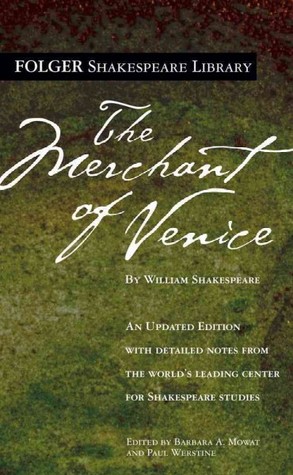
The Merchant of Venice by William Shakespeare (1596)
A complex tale of law, love, and loyalty, of marriage, mercy, and money, of racism, religion, and revenge, of debt, destiny, and disguise.
Play Review: The Merchant of Venice is one of the most striking examples of "of its time" I've ever read; this is comedy? The play itself is quick, easy, and enjoyable. I read for plot, wondered what might happen next in the twists and turns -- it seemed almost like a novel. The more I read Shakespeare the easier he is to comprehend. I've become accustomed to his poetic, metaphorical language. Once again Shakespeare creates indelible female roles, Portia being one of his best: strong, intelligent, and riding to the rescue with her brilliant "quality of mercy" speech, saving all the men. But once again in Shakespeare we have a woman whose marriage is held hostage by her father, even after his death. Portia knows she's more clever than all her suitors, regretfully telling her future husband: "I was the lord/ of this fair mansion, master to my servants,/ Queen o'er myself," but now all that will be his. Jessica must also be an incredible role to play in its complexity, an actor deciding how to play being torn between two worlds ("what a heinous sin is it in me/ to be ashamed to be my father's child," described by her lover as "wise, fair, and true"). It's far from clear that Jessica will ever be accepted by the Christian world.
But I'm delaying the inevitable, the strongest role in the play, and the elephant in the review. When reading novels I understand the societal influences of its time, recognize what would be unacceptable today, and can enjoy the book despite elements I couldn't tolerate in a contemporary book. But The Merchant of Venice seems mean-spirited, even for 1596. I can make excuses: Shakespeare apparently never met a Jewish person (Jews being expelled from England in 1290); the prejudice against Jews was common and accepted; good Christians were not to charge interest on loans; Elizabethan Christians were obsessed with converting the Jews (as represented in the play -- two of three Jewish characters are converted); and Shylock is allowed to provide some part of his side of the story. But on balance the scale still tips to the wrong side. Antonio is presented as a paragon of virtue, but he hates Jews, calls Shylock a dog, disparages his religion, kicks him, spits in his face. Shylock says (without dispute) that Antonio "hath disgraced me ... laughed at my losses ... scorned my nation ... heated my enemies -- and what's his reason? I am a Jew." This is not how a "good" Christian treats a fellow human. Shylock notes that the Christians, being slave-owners, have unclean hands. To justify his revenge upon Antonio, Shylock makes his famous speech: "Hath not a Jew eyes ... if you prick us, do we not bleed ... if a Jew wrong a Christian, what is his humility? Revenge ... the villainy you teach me I will execute." Which could be Malcolm X and Ta-Nehisi Coates talking about the chickens coming home to roost. For me, every time Shylock is referred to as "the Jew," with or without other epithets, it's like a small slap in the face. (Portia's suitors come in for additional arrows.) At the end Shylock is forced to convert to Christianity (as his daughter did voluntarily). He also loses half his property to Antonio. The punishment seems cruel, but he was willing to kill Antonio in forfeit of his debt. Death for a debt (even contractually) seems barbaric, but this dramatic choice by Shakespeare also has the despicable smell of blood libel in Shylock's demand for a pound of flesh, and subsequent denial of a drop of Christian blood. Although The Merchant of Venice was written in his time, we read Shakespeare in our time, and cannot simply ignore what we know, cutting out conscience, ethics, and morals like Shylock's pound of flesh. Of course Shakespeare wrote his plays in savage times, when the horror of bear-baiting was considered good entertainment. But being of our time we can also recognize what I believe is Shakespeare's gentle and generous portrayal of Antonio's unrequited love for Bassanio. The Merchant of Venice is a play I greatly enjoyed, despite, except for, what was inextricably, regretfully, painfully, of its time. [4½★]
Wednesday, September 27, 2017
Return of Banned Book Week 2017
As mentioned above, no books in our society are actually banned. Any real limitation takes place at the publishing level where certain books simply don't get accepted for publication. But self-publishing is still available (see Joy of Cooking, The Martian, A Christmas Carol). So really this talk about "banning" is somewhat exaggerated. But only somewhat, as I see the hysteria of Banned Books Week as a bulwark against censorship yet to come. As recently as the 1960s efforts were made to actually ban books in the U.S. Other countries still have banned books. I see First Amendment warriors as pushing Banned Books Week with such enthusiasm to maintain a weapon for use against any future government effort to actually ban a book. Can we say, in times such as these, that it's impossible? So "thank you!" to those who stand on guard today, for that tomorrow when the book burnings start. 🐢
Monday, September 25, 2017
Banned Books Week 2017
Banning books seems futile. Stupid, in fact. Banning may well validate the ideas in a book by marking those ideas as important and meaningful enough to ban. Trying to silence a work may make the entity look weak and afraid. Or censorship may make the book seem like forbidden fruit such that readers are all the more eager to read this mysterious morsel. Perhaps condemning books brings attention to a book that otherwise might just fade away due to lack of interest. And banning may engage those people who disagree with a book's sentiments, but will defend to the death the right of those sentiments to be heard.
The most common books bans are for being age-inappropriate. These are partial bans that restrict a book from people of a certain age or at an individual school, when people can still obtain the book, just not quite as easily. While it's worthwhile debating such books and the gray areas they create, probably a majority of people would agree that some books should be kept from some children; in our society we try to protect children. At least from sex. Usually we keep "dirty" books from children, such as Catcher in the Rye. In the past, we've also tried to protect adults from literature that's a little too sexy. This has happened with notable literature such as Lady Chatterley's Lover, Ulysses, Lolita, A Farewell to Arms, and even a poem, Allen Ginsberg's Howl. Today it seems unlikely that much is censored from adults for being too sexual, but the church will try, because religious censorship is another huge force in the world of book banning. After obscenity (too much sex), the next big category for religious censorship is blasphemy such as The Satanic Verses, Candide, and (believe it or not) Carrie, The Da Vinci Code, and Animal Farm. Even Faulkner's As I Lay Dying was censored for questioning the existence of God. But I could've written that as "god." Given the theocracies that still exist in the world, there's an overlap between religious and political censorship (see above, The Satanic Verses). The biggest political book banners are dictatorships and other authoritarian regimes. That means books like Animal Farm, Dr. Zhivago, The Master and Margarita, and probably anything written by Alexander Solzhenitsyn. Yet even The Communist Manifesto and Mein Kampf have been forbidden in democratic countries. While there are other categories, one last common reason relates to "lifestyle," such as novels portraying homosexuality, drug use, or promiscuity -- a bewildering combination. I'll make no suggested reading for Banned Books Week, because every week is banned books week. 🐢
Friday, September 22, 2017
A Midsummer Night's Dream by William Shakespeare (1595)
In city and in wood, four couples span the spectrum of love.
Play Review: A Midsummer's Night Dream is a play about love and the imagination, perhaps written by someone who was in love at the time. The various elements of the play echo the elements of love. There is fantasy and magic, passion and crudeness, jealousy and anger, beauty and confusion, comedy and tears. Lovers' quarrels and the games lovers' play, all are here. Who hasn't felt like an ass when struck with love? Even oafish but lovable Bottom, seemingly the last person to ever to fall in love, suddenly encounters the unexpected and doesn't quite know what to make of it. The play spans the spectrum of love (of the time) from the quiet, stable passion of Theseus and Hippolyta, to the spell-struck love of Titania and Bottom, to the comically and clumsily enacted love story of Pyramus and Thisbe (similar to Romeo & Juliet). There is also desire, not only the desire of the couples for each other, but the desire of the audience for the young lovers to succeed. (Well captured by the 1968 British adaptation of the play, with Judi Dench.)
The world of A Midsummer Night's Dream is divided into the sensible, civilized city and the wild, chaotic wood. The city is ruled by the restrained logic of its King, Theseus, and the wood by the untamed emotions of its rulers Oberon and Titania. In the city Egeus can make harsh demands under the law (he insists she marry a man other than the one she loves -- much like Juliet) and receive an orderly hearing (he accuses Lysander of having "bewitched" his daughter -- little does he know!). In the wood anything is possible and everything can happen, no rules, no limits. "Bewitched" is an understatement.
All the female roles are especially engaging, well rounded and individual, compelling and attractive: the Queen of the Amazons, strong, proud, and reserved; the Queen of the Fairies, strong, fanciful, but deceived; and two lovely girls whose only wish is to love and be loved. Helena and Hermia are best of friends become bitter rivals. The interplay between the four lovers is complex, both comic and heartbreaking. Hermia has two suitors though she loves only one (though Demetrius first loved Helena before Hermia, fickle as Romeo), then Helen has Hermia's two lovers, but believes neither. Helena is as irrationally (or youthfully) infatuated with Demetrius ("I am your spaniel ... to be used as you use your dog") as Demetrius is with Hermia (she says, "I give him curses, yet he gives me love," "The more I hate, the more he follows me"). Hermia boldly swears to meet her love, Lysander, "By all the vows that ever men have broke/ (In number more than ever women spoke)." Helena challenges social norms and Demetrius' gentility: "Fie ... Your wrongs do set a scandal on my sex. We cannot fight for love as men may do. We should be wooed and were not made to woo." But at night in the wood, Hermia modestly tells Lysander, "For my sake, my dear,/ Lie further off yet. Do not lie so near." Egeus, Hermia's cruel father, is the only unredeemed character in the play, Theseus generally seeming fair and sensitive (for the times, I like how in the first scene he carefully left Lysander and Hermia alone to commiserate). Oberon is more mercurial, but not without his better moments; he's capable of wrong, but also does right. Lysander and Demetrius are ruled by their passions, enchanted and otherwise.
Throughout the lovers' play, there is the comic relief provided by Oberon's servant, the mischievous Puck (Robin Goodfellow), and by the rustic tradesmen awkwardly attempting to stage a romantic play for the Duke's wedding. And the faint reminders of Romeo and Juliet. But there's also the Duke's insight that "The lunatic, the lover, and the poet" all live solely in their imaginations. Imagination and love is the essence of A Midsummer Night's Dream, as it ends with a horde of wild fairies from the magic wood invading the Duke's palace to bless the happy couples. [4½★]
Subscribe to:
Posts (Atom)