Tuesday, November 29, 2022

The Red Lamp by Mary Roberts Rinehart (1925)

A rational college professor inherits a house that may be haunted, or worse.

Mystery Review: The Red Lamp leaves the reader wondering: is it a ghost story or a romance, is it the supernatural or is there a rational explanation for the odd goings on, and what about the mystical red lamp? There's a Wilkie Collins feel to this novel. Clumsily written in journal entries that can slow the pace, we gradually learn all as the narrator fears that he's the police's main suspect in various mysterious deaths. Red herrings abound. The characters are not well developed, and some faded into anonymity including the main suspects and the narrator's wife. There is no effective detective except for the romantic lead who's working overtime. The Red Lamp includes a little bit of shy romance, with nary a kiss, but a bit of (hundred year ago) Twenties banter. Mary Roberts Rinehart (1876-1958) was sometimes called the American Agatha Christie (though she wasn't the only one, see Mignon Eberhart), and while she may have been as productive and successful as Christie in her time, her work is not as effective or convincing as to warrant that title. She did, however, enjoy writing frequently about spooky old houses and the mysterious, possibly supernatural, deaths of the old folks who owned them. Despite that, The Red Lamp was too all over the place to be more than only adequate entertainment.  [3★]

Monday, November 28, 2022

Fata Morgana by William Kotzwinkle (1977)

A French detective in 1861 Paris hunts a criminal who may employ the supernatural.

Book Review: Fata Morgana is a mirage, an illusion. Which is the story of Paul Picard, the bear-like detective who relentlessly pursues his quarry while trying and failing to live life to the fullest. I'm not much of one for the supernatural but this story won me over. While not as layered as an onion, the novel is more subtle than it first seems and in the end there's a life-affirming moral with a comment on when duty outwears common sense. Kotzwinkle makes the historical narrative, the magic and mysticism, the larger than life characters in Fata Morgana seem effortless. He powerfully evokes the time and place, the exotic and erotic, the appealing character of this lumbering ursine policeman as he jostles through the demimonde. Kotzwinkle is the ultimate professional and facile writer, but there's more here than meets the eye. He really should be better known, but he writes in a wide variety of genres with no two novels are alike -- in fact they're widely divergent. He writes children's stories, adult novels, novelizations, and always seems to have a bit of tongue in cheek, while his writing is so facile, florid, and fluid that one hesitates to look for depth, which is there hovering just below the surface. Fata Morgana is a fantastical romp that entertains on a high level.  [5★]

Sunday, November 27, 2022

The Roman Hat Mystery by Ellery Queen (1929)

A lawyer is murdered during a Broadway play in a secured theater.

Mystery Review: The Roman Hat Mystery is the first case for dilettante sleuth Ellery Queen, whose adventures are vaguely patterned after Sherlock Holmes. Queen, a young mystery writer and amateur detective works closely with his father, a senior police Inspector who serves as a brighter Watson to his son's Holmes. The father-son relationship is central to the story, but is strangely co-dependent and definitely odd. At least one of the authors must've suffered from a pathological lack of patriarchal approval. Here they investigate what's essentially an elaborate locked room mystery set in a Broadway theater. The mystery itself is overly complex but not impenetrable, centering on a missing top hat (the hat of the title). The characters are only moderately interesting (though not up to even Agatha Christie standards) and not overly developed. The Roman Hat Mystery is mainly a puzzle story with some clues hidden from the reader. The son's implausible involvement in the investigation (no police department would tolerate it) just has to be swallowed as well as his condescension and occasionally supercilious mannerisms. He wears a pince-nez, and seems vaguely like an American Peter Wimsey. Author and protagonist are one and the same here, though actually the authors were two Brooklyn cousins who jointly wrote numerous books from 1929 to 1971. "Ellery Queen" (the author), was also an anthologist and magazine editor and has been called "after Poe, the most important American of mystery fiction." Today, however, he's largely unknown and apparently hasn't aged well. The writing can be cloying and there's a measurable amount of cringe-inducing racism. The Roman Hat Mystery was my first Ellery Queen, and an adequate but not great start to the long running series.  [3★]

Tuesday, November 1, 2022

The A.B.C. Murders by Agatha Christie (1936)

Hercule Poirot must stop an alphabetical serial killer before another murder occurs.

Mystery Review: The A.B.C. Murders is the twelfth Hercule Poirot book and loyal sidekick Captain Hastings is once again along for the ride, but refuses to narrate the whole novel. This installment has more urgency than the average Poirot mystery. Usually the master detective is solving a murder in past tense, whereas here we expect the murders to keep cascading until actively stopped. The story is over the top elaborate but still credible as entertainment and close to possibility. In The A.B.C. Murders Christie carefully constructs a puzzle, finding new ways to join traditional mystery elements to divert and baffle the reader. Before I started reading Christie my assumption was that her many mysteries must've rolled off an assembly line. Not so. In each she creates something unique and different, even if not especially profound. In Christie's world the characters expertly serve the plot, unlike today's more deeply psychological crime stories in which we spend more time in someone's mind than in solving the mystery. As always, she is the virtuoso of the red herring. The A.B.C. Murders was something completely different and still dependable entertainment.  [4★]

Monday, October 31, 2022

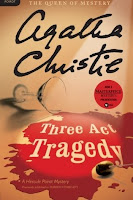
Three Act Tragedy by Agatha Christie (1934)

A murder occurs at each of  two parties attended by the same guests; could there be a connection?

Mystery Review: Three Act Tragedy is the tenth Poirot book, also known as Murder in Three Acts (original U.S. title). This is not a play, but Christie does spread the thespian metaphor throughout the novel.  Hastings fails to appear in this installment. Instead Mr. Satterthwaite (who appears in two other Poirot works) ably serves in his stead and also provides the requisite anti-Semitic comment. Misogynistic comments also occur. The pace in Three Act Tragedy is slow and deliberate although Christie spreads the narrative over several characters. Poirot disappears for a lengthy section and then has an extended summing up at the end. There are  a couple of clever twists (one tying into the title) that make the story a little more interesting. The book ends on a tragic note that could have been expanded into a more heart-wrenching scene. Three Act Tragedy was better than average Christie, though when reading I'd already seen the BBC (David Suchet) series adaptation, which might've colored my thoughts.  [3½★]

Sunday, September 11, 2022

Lord Edgware Dies by Agatha Christie (1933)

Poirot helps an American actress seek a divorce, but the next morning her husband is found murdered.

Mystery Review: Lord Edgware Dies is the eighth Poirot book (also known as Thirteen at Dinner at one time in the U.S.). Hastings is back from the Argentine to narrate, now adorned by a "toothbrush" moustache Poirot describes as a "horror" and an "atrocity." As usual Hastings gives Poirot too little credit, Poirot gives Hastings none, and at some point Poirot berates himself for his own stupidity. Lord Edgware Dies is a better than average installment, a clever mystery with the usual tempting and efficient characters and posing the question of how someone can be in two places at once. Christie has fun in one exchange as a character says: "Good title that ... Lord Edgware Dies. Look well on a bookstall." Christie's casual and nonchalant anti-Semitism has begun to be unbearable. A college thesis could be written about it. Even when she doesn't attribute negative or stereotypical behaviors to her Jewish characters (which she often does), every Jewish character must be identified as such ("now that he mentioned it, I saw the faint traces of Semitic ancestry") for no apparent reason. Ick.  [4★]

Friday, June 17, 2022

The Bellamy Trial by Frances Noyes Hart (1927)

A murder involving two wealthy couples in suburban New York ends up at trial along with attorneys, witnesses, physical evidence, and a clamoring public.

Mystery Review: The Bellamy Trial had so many tricks and turns at the end I wondered if it was the Gone Girl (2012) of its day. Not a detective novel but a 1927 legal whodunnit, with each chapter being a day of the trial replete with witnesses, evidence, posturing attorneys, and a packed courtroom. Thus, the reader is enjoyably placed in the position of being a juror, making snap judgments of credibility and veracity day after day. The story is intricately put together and paced allowing the mystery to work well in this unusual setting. The various relationships between the wealthy wives and husbands and their admirers is almost Byzantine. The status differences between country club and laboring class provide a revelatory subtext. Along with the many characters presented from the stand there's a bit of silly romance between a seasoned reporter and a red-headed first-timer sitting in the gallery that gives a break between the days of trial (each a chapter) and subtly provides insights into various aspects of trial procedure and town history. Very much of its time, which only made it all the more interesting. The story is based on an actual 1922 scandal, which may have also inspired The Great Gatsby (1925). One warning: much like the aforementioned Gone Girl the ending results in an ethical dilemma that will leave some readers dissatisfied.  [3½★]