Oh, I really dislike book reviews with long summaries of the plot. Really, really do. Let me count the ways.
First, a lengthy plot outline sounds like someone trying to give a high school book report, fussing over "was it Marianne, or Miriam, no Marianne, or Minnie? In 1945?" So often the reviewer goes into a strange level of detail, none of which makes no never mind to the reader or listener. So often the reviewer gets the facts wrong anyway. Listening to someone giving a high school book report gives me the creeps. High school wasn't that great.
Second, I want to learn the plot as I read the book, not from reading or listening to a review. I want to go in blind as possible, and I find I enjoy books best when I have the fewest preconceptions. Maybe your summary has more spoilers than you think? I don't even read the blurbs on the back of books because I find them too spoilery.
Third, there are a dozen places to find a summary of the plot if I want one, I don't need you to do that for me. Many others have summarized all the books before, we don't need another plot outline. Especially for famous books, no summary needed! You don't need to outline Harry Potter, Twilight, Hunger Games, or Gone Girl for me. I've heard. Listening to several reviews just means several redundant plot summaries. Ouch. Overload.
Fourth, I want to know how the reviewer felt about the book, what emotions did it raise, was it accessible or difficult, does it relate to any other books, was it funny, deep, angry, confusing, quick? Was it a slow read? Is it the author's best? Worst? Different from her other works? Were the characters interesting, unlikable, realistic? Did you hate it, love it, meh it, and why? There's so much you can tell me about a book that's more interesting than the plot. What did you think?
Fifth, the creativity in book reviewing certainly doesn't come from a plot recital, it comes from some unique perspective that you and only you can provide. That's what I want, your individual take on it that I won't get from anyone else. What did it remind you of, what does it relate to, how did it touch you?
In my own reviews I try to limit my summary to a single line at the beginning, and only such plot elements as are necessary to give you a sense of the book, but always abbreviated. Sometimes probably too short, but as I mentioned, if you really want to know a book's plot ahead of time, there are plenty of places to find it.
So that's my rant, hope it made some kind of sense, thanks for listening. Nuff said.
Friday, September 16, 2016
Wednesday, September 14, 2016
Heartless by Gail Carriger (2011)
The fourth appearance of the indomitable Alexia Tarabotti Maccon and the Parasol Protectorate series.
Book Review: Although the stage in Heartless doesn't leave the Victorian environs of London and Alexia is heavily gravid throughout, it may be the most action-packed installment yet. Bigger roles for Professor Lyall, Felicity, and ghosts, and the appearance of deadly porcupines give the story more variety, and women's suffrage even makes a brief appearance. Both Ivy and Alexia separately go undercover, and the English capital suffers significant damage. Additionally, the pseudonymous Gail Carriger seems to have done research to provide Heartless with more local and temporal color, so if you enjoyed the previous iterations, this should tickle your funny bone as well. It's still steampunk, humor, mystery, vampires, bustles, tea, aristocrats, and werewolves. By the end much of the social order has been turned upside down and much is left unresolved (tho Carriger's obsession with a well-tied cravat remains the same as ever). Even so, little has changed and Heartless is another enjoyable, fun, and entertaining episode in the Parasol Protectorate (now formally named) series. Timeless is the next and final book in the series; I'm on page two. [3 Stars]
Monday, September 12, 2016
In the Woods by Tana French (2007)
The first in Tana French's Dublin Murder Squad franchise; a young girl is found murdered near Dublin, echoing the disappearance of two children there 20 years before, which involved one of the Squad members.
Book Review: In the Woods is a debut novel, a mystery, and has no right to be so good. If you want a warm, cozy, comfortable, mystery with a fully resolved and happy ending, this is not your book. It's not one of those cinematic novels coasting along a visual surface, rather it goes deep into hearts and minds and rough, painful emotional depths. At the end I hurt, too. This also is not a hard-boiled detective story, you'll know and care about these characters. Tana French invests her words with great weight: at the victim's autopsy a detective thinks, "she was so small." I got chills. The detectives dissect the smallest facial twitches, searching for clues to solve the murder, and to solve the tensions between them. Although more character- than plot-driven, there is still a mystery that drives the story along, and at one point I could not put the book down, reading well into the morning from the other side of the night. In the Woods has chilling, gothic elements that I didn't expect, but brought a twisted and disturbing side to the story. French also includes (small) touches of humor, and an underlying theme of rich versus poor, government versus citizenry; interesting how the government seems more like an occupying force than a representative of the people. I enjoyed In the Woods, Tana French is an impressive writer, this is an impressive book, and I'll be reading the next installment in the series, The Likeness, but maybe something a little lighter first. [4 Stars]
Thursday, September 8, 2016
Maestra by L.S. Hilton (2016)
Judith, an amoral young woman will do anything for money except, after being sacked, get a job.
Book Review: Maestra is the effort by L.S. (Lisa) Hilton to write a new, but more upscale and fatal version of 50 Shades of Grey, a book for our times. It ends up being the literary equivalent of a glossy fashion magazine edited by Dan Brown, if Brown was only interested in clothing, art, money, travel, homicide, shopping, food, and sex, in that order. Sidney Sheldon, Jackie Collins, and the Financial Times are other names that come to mind. Anything is acceptable in the pursuit of money; sex is an afterthought. Narcissism is the new religion; greed is good. Judith is willing to pay 1000 Euros for sex and a little light S&M, but then shoplifts from a small shop. There really isn't that much sex (tho Hilton is aiming for erotica, perhaps porn, and this is an adult book), and what occurs is meant more to shock than stimulate, but to each her own. Love is a foreign country, friendship is a distant shore. The most interesting relationship in Maestra is entirely asexual. According to Lisa Hilton (or is that Paris?), our beautiful heroine's motivation is "rage," but actually it's only greed and self-satisfaction. The death of three or more innocents, her best friend losing his job, none of these deter our heroine. In Judith's world, "no lives matter," and being irksome is punishable by death. It's readable, tho not overly well-written (forget reasonable or plausible); only stubbornness kept me from DNFing. If you enjoy glossy fashion magazines, descriptions of posh clothes, fancy food, exotic locales, and Eurotrash without any pesky morality, logic, or human interaction, Maestra is the book for you. Since this has already been announced as a trilogy, you know how it ends. [2 Stars]
Wednesday, September 7, 2016
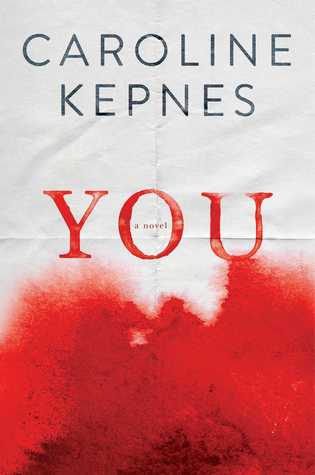
You by Caroline Kepnes (2014)
Joe, a bookstore clerk, will do anything to win the love of his obsession.
Book Review: You wasn't bad. I didn't hate it. But everyone loved this more than I did. Maybe it's just me, maybe I had a headache, maybe I shouldn't have read You after reading Room. Maybe I don't find stalkers all that funny. For me the first half was painfully slow going, predictable, I didn't buy into the characters, they seemed unreal, almost comic book or just over the top. In the second half the story picked up, the characters became more believable, and I started to speculate where the plot was going. Still, I don't get why so many people are enamored with our narrator Joe, the murderous stalker. There was a lot of detailed social media hacking going on, which gave You a contemporary take on the traditional stalking story, and Joe's cyber stalking talents may make him seem cool. The narrator also suffers from class rage, and repeatedly rants about the hipster, richie, yuppie scum (who all deserve to die) he encounters while stalking his prey. He also has a sarcastic, gimlet-eyed sense of humor, but since much of the humor seemed obvious it didn't hit my funny bone. You reminded me of some distant cousin of Dexter, but without the charm or sense of mission, maybe Dexter-lite. Which led me to conclude that we like Dexter because he's handsome, charming, and only kills bad guys; he's what we want our serial killers to be. And Joe is what we want our stalkers to be. He mostly only kills rich, white people. He's funny, bookish, romantic, and in love, like an awkward, overeager but unfortunately homicidal boyfriend, instead of a real stalker driven by rage, power, and control determined to force his victim into a life of fear. Of course, they both kill and rape. But all is forgiven so long as you're funny, quirky, and clever. And You comes in a nice acceptable package. Caroline Kepnes can write, the writing was fine, the tone was consistent, but You just didn't work for me beyond the average thriller stalker novel. As you can see from the ratings, however, I'm in the minority on this one and the masses, everyone and their cousin, have roared their approval. [2.5 Stars]
Monday, September 5, 2016
Room by Emma Donoghue (2010)
A five-year-old boy and his young mother live in a small room, which is the only world he's ever known. {Spoilers below!}
Book Review: Room is a difficult book to discuss without spoilers, so this will be a discussion with spoilers. Sorry. I only knew a little about the book before I read it, which added to my enjoyment. Of course now, with the popularity of the book and movie, it's going to be hard for future readers not to be spoiled somewhat. The basic story is that a young woman is kidnapped by a rapist and held prisoner in a small, sound-proofed garden shed, where she gives birth to her son. Room is told from the point of view of the precocious five-year-old boy, Jack, with all the insights and limitations resulting from that. He has only ever spoken with his mother ("Ma"), and so has an almost adult vocabulary, but he also has the speech deficits that a mother would tolerate. Jack has only ever lived in this one room and everything, including the few inanimate objects such as a table or a rug, are personalized and humanized. Irish writer Emma Donoghue has completely captured the tone of Jack, Ma, and Room, and the strength of this voice propels the story and the reader through the whole of the book. I truly felt like I was living in that room with Jack; I began to feel as tho every object and every bit of food was precious, and my world was 11 feet square. Claustrophobic. The story and tone was credible and compelling; it felt so realistic it began to creep into my mind. The book is divided in halves: before and after the rescue. How Jack escapes the room is problematic on a couple levels, but I think Ma hoped Jack would get out earlier than he did, when there would have been more people around on the street, and she knew Jack was more than an average five-year-old. The attempt also showed her absolute desperation, her willingness to risk anything to escape the room for several reasons, not the least that Jack is getting older and his life will be in danger. I found the first half of Room more engaging than the second, but there was still plenty in the slower second half of the book to keep me reading. I think readers might prefer either of the two halves of the story. The story of life after the rescue was again quite believable tho more subtle. The emotions and stress (everything is not suddenly perfect after the rescue) involved in adjusting to life after the room let's us see our everyday world anew, through Jack's eyes. Even in the abundant outside world, every little thing (a leaf, a bee) is magical to Jack. We learn that Ma's name is Sharon, and although Jack is the narrator and we see everything from his point of view, I think that made Sharon's story even stronger. We read Jack's words reflecting his limited understanding of what is going on in the room (and afterwards), but we as omniscient readers understand more, and that makes Sharon's suffering even more resonant, because we read the full measure of pain, misery, and victimization into the story, but we also see her struggle, her strength, resilience, and determination to overcome the prison in ways that Jack cannot. Even one of the creepy aspects of Room, the nursing, worked to show the bonds between Jack and Ma, their individual needs, nourishment on other levels. The ending surprised me, but was just as it should have been. Emma Donoghue has written a very quick read, a kind of thriller, one you may be unable to put down. I read it in two or three sittings. Room is a tour de force, by which I mean the author has taken a specific focus, a limited scope, and made it into something much bigger and more powerful. Room is a solid and successful story, well done, and a great read. [4 Stars]
Friday, September 2, 2016
Blameless by Gail Carriger (2010)
Not only is her life in danger, but Alexia is being shamed by London society; accordingly, she (with Floote, and Madame Lefoux) travels to France and Italy in this third installment of Gail Carriger's Parasol Protectorate series.
Book Review: Blameless is good fluffy fun, the romance still decreasing, the steampunk still increasing, this volume of the comedic mystery thriller series seems even more sedate than the previous two iterations (if you're reading this, I gotta assume you've read at least one of the two previous works). Even when violence and danger are swirling, Carriger moves the the story along deliberately with no sense of panic, just right for Victorian England (and with another cameo here by the Queen, herself). Although I found this less compelling than Soulless and Changeless, it still kept me reading, even through the slower moments. Blameless is still very English: "'It would be terribly arrogant of us British to think England was the first and only progressive society.'" Carriger's humor is still rich (whack-a-mole makes an appearance!) and Alexia is still Alexia despite a death sentence on her head: "Should her future permit it, she would spend the rest of her days relaxed in an armchair in a library somewhere. Adventuring was highly overrated." And the term "Parasol Protectorate" makes its first appearance; I'll let you guess who coins it. Blameless is still enjoyable entertainment, even with beach season reaching its end in the northern hemisphere. My intention is to finish the next two installments (Heartless and Timeless) in Gail Carriger's series soon. I've got to know how it all ends! [3 Stars]
Subscribe to:
Posts (Atom)