Monday, May 2, 2022

The Chocolate Cobweb by Charlotte Armstrong (1948)

Twenty years later, a possible maternity ward switch leads to murder.

Mystery Review: The Chocolate Cobweb is clever, innovative, occasionally far-fetched, and an entertaining and compelling read. Featuring a brave and resourceful young woman as protagonist, this is a modern gothic suspense tale with a touch of romance. The prolific Charlotte Armstrong (1905-69) reveals the murderer early on, but can they be stopped? Despite the cringey title, The Chocolate Cobweb (it makes sense after a few chapters) is what's apparently called "domestic suspense" and isn't a cozy mystery. Unpretentious, entertaining, dramatic. A psychological thriller. In 2000, The Chocolate Cobweb was also made into a French film titled Merci pour le Chocolat (in English: Nightcap) with Isabelle Huppert, directed by Claude Chabrol. Truth, this isn't the cover of the book I read (from the American Mystery Classics series), but I like it so much better.  [3½★]

Cocaine Blues by Kerry Greenwood (1989)

Phryne Fisher travels from England to Australia to save an aristocratic young woman, encountering cocaine rings and murderous abortionists along the way.

Mystery Review: Cocaine Blues (aka Miss Phryne Fisher Investigates) is the first of the Phryne Fisher mystery series.  Well researched, at times even over-researched. Kerry Greenwood may know every building on any particular Melbourne street in 1920, but I don't need to do so. Having done all that swotting, naturally she wants it on the page. I know Miss Fisher from the television series (and the spin-off Ms. Fisher's Modern Murder Mysteries), which is excellent and portrays the characters a bit differently (Dot and Inspector Robinson seem particularly reimagined). Essie Davis wears ravishing outfits in the shows and the fashion-porn descriptions in Cocaine Blues are no less well done. The mystery isn't the center of the story, which is focused on introducing a charming cast of characters and an engaging Australian atmosphere. Although I prefer the television series (which I saw first), Cocaine Blues is only minimally less entertaining and continues the can-do attitude of the shows.  [3½★]

Sunday, May 1, 2022

Love in the Big City by Sang Young Park (2019)

The days and nights of a young, gay man living the fast life in Seoul.

Book Review: Love in the Big City is the first book published in English by this new South Korean author. Being bad Buddhists there's much we want from the world, but life ensures we don't get what we desire, and when we do we may fail to accept it. That thought remained after reading this novel about love: love of friends, family love, love of lovers. While Park's focus is clear, effective, and valuable, the story is more simply about people, human beings, those entities we try constantly to understand. Anyone will find some tugging of the heart: a mother dying of cancer, a feeling unspoken, recognizing a kindness. The honest and straightforward presentation of the four interrelated stories worked well in this brief coming of age story. The protagonist matures, realizing that people are beautiful because we love them, we don't love them because they're beautiful. While reading I wondered what This Side of Paradise would've been like if Fitzgerald could have written with the simple honesty of Love in the Big City. There's a hint of the "gay love is bad love" feeling, but isn't it just that for everyone love doesn't work out until it does. Any love can be miserable. Life is a series of failed relationships until one doesn't. This is a book I could read again in a year and find more to value. I thought I had some knowledge of Korean culture, but Love in the Big City required several searches for background, although it's wonderfully translated by Anton Hur.  [4★]

Goodbye, Columbus and Five Short Stories by Philip Roth (1959)

Philip Roth's first work, a novella and five short stories.

Book Review: Goodbye, Columbus was published in 1959 when Philip Roth (1933-2018) was 26. This edition contains the title novella, five short stories, and the seeds of genius that speaks to history. It has the sense of autobiography of earlier authors such as Hemingway and Fitzgerald, while looking forward to a different expectation of the world. Roth falls into the young writer's trap of believing that the essential subject is one's first experiences with love. Because the whole world must be interested in what the writer is obsessing about. It should be against the law for novelists to write about their early relationships until they're at least 35 (even though here it's a metaphor, and so ... meta). Although Goodbye, Columbus is seemingly about Jews, as presented by other mid-century American writers such as Bellow and Malamud, this is really more about the immigrant experience in America. About leaving the past behind, saying goodbye to a world that can't last (the title is a subtextual reference to the first immigrant), and about what Roth thinks the current generation should be doing with their opportunity. His protagonist (and alter ego) Neil is shallow. He loves Brenda because she is what he is not, but he knows "no more of her than what I could see in a photograph." The heart of the story is the black boy looking at Gauguin books in the library. A parallel to Neil, but without the advantages, and for both there was "No sense in carrying dreams of Tahiti in your head, if you can't afford the fare." The novella is satire, but at times ungenerous, with a lack of empathy. Roth sees the communal flaws, but with the arrogance of youth he doesn't acknowledge the roots of those failings (actually he does once, in the story "Eli, the Fanatic"). The five stories are a mixed bag, but Roth uses them as explorations and experiments, finding out how and what to write. I can see various readers choosing any one of them as a favorite, mine being the difficult "Defender of the Faith" and the hallucinogenic "Eli, the Fanatic." As an aside, I enjoyed the passing reference in Goodbye, Columbus to Mary McCarthy as the conductor for youthful sexual exploration.  Also a mediocre 1969 film with Ali MacGraw and Richard Benjamin.  [4★]

Pitch Dark by Renata Adler (1983)

A woman who knows better examines her affair with a married man.

Book Review: Pitch Dark is an intelligent novel in which we learn much about the narrator and little about the object of her interest. Muriel Spark says it best in her incisive and insightful Afterword: "Renata Adler's novel Pitch Dark, like her first work of fiction Speedboat, is a genre unto itself, a discontinuous first-person narrative." After the two novels Adler wrote no more fiction; her unique, experimental style was a dead end. Although "discontinuous," presented in a jumble of cutting and pasting one or more linear narratives interspersed with set additions and recurring lines, ultimately it's formulaic, going round and round in predictable and comforting circles. Although more plot oriented, Pitch Dark adds little to Speedboat. In both the emotion just below the surface is sublimated to technique and becomes an underlying tension. Adler is wonderfully intelligent and captures the zeitgeist well. But once the reader gets past the experimental artifice there isn't as much there. And the occasional expression of Adler's reactionary beliefs can get tiresome. Although I'm happy to've read one of her novels, I didn't need to read both. Worth it, perhaps, if only to appreciate Spark's brilliant commentary.  [3★]

Wednesday, July 21, 2021

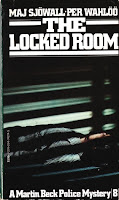
The Locked Room by Maj Sjowall and Per Wahloo (1972)

A woman robs a bank and a man dies in a locked room; the two events couldn't be connected ... .

Mystery Review: The Locked Room is the eighth Martin Beck mystery, replete with all we've come to expect: intense social commentary, a dissection of the Swedish police, human beings barely escaping depression. A classic locked room mystery is not what we've come to expect from Sjöwall and Wahlöö, but they do it well and this is as good as any book in the series. The authors hit a high point a few books back and have managed to stay there consistently. The mystery, the interplay of familiar personalities, the description of police procedures (and the occasional humorous bumbling) are only half the story. The other half is the social critique of Swedish society, the police force, what's happening to Stockholm. They all seem to be going in the wrong direction. There seems to be an intense frustration behind The Locked Room. The authors even give us some ethical conundrums to chew on (can one chew a conundrum? perhaps only in a mixed metaphor). Beck himself has a limited role here as he's recovering from the gunshot wound received in the previous installment, but he's still the straw that stirs the drink. As much as I enjoy gradually getting to know the recurring characters as they unravel mysteries, it's the chance to get a glimpse of Sweden at a certain time that I appreciate almost as much. The Locked Room is another success.  [5★]

Thursday, April 22, 2021

The Curious Case of Benjamin Button by F. Scott Fitzgerald (1922)

What if ... we aged backwards.

Story Review: "The Curious Case of Benjamin Button" is one of Fitzgerald's fantasy pieces, a sharp turn from the popular flapper stories in which he chronicled the mercurial emotions of the Roaring Twenties (our current Twenties aren't off to quite the same start). Originally published in Collier's magazine and collected in Fitzgerald's hodgepodge of a second story collection, Tales of the Jazz Age (1922); many years later it was made into a 2008 film with Brad Pitt and Cate Blanchett. Perhaps it's an early look at magical realism. The story almost seems a finger exercise in which the author set himself a puzzle: he took a premise and extended it into a full story that explored the possibilities of how it all might play out. After reading, one notes "youth is wasted on the young" and wonders why a lifetime of experience and learning coincides with a weakening body and approaching death. Cited as a satire on aging, "The Curious Case of Benjamin Button" is an even more pointed satire of societal requirements that we conform to expectations, as Mr. Button certainly does not. His march to the beat of a different drummer sends everyone into hysterics. He faces intolerance every step of the way. I felt the story had a surprising emotional resonance the first time I read it, and it's one that I've never forgotten. Haunting as well. Even just as an oddity, an imaginative detour for those with creative minds, "The Curious Case of Benjamin Button" sticks with the reader and is a necessary read.  [4★]